
CGPA to Percentage Conversion Guide: Official CBSE, College & University Formulas (2026)
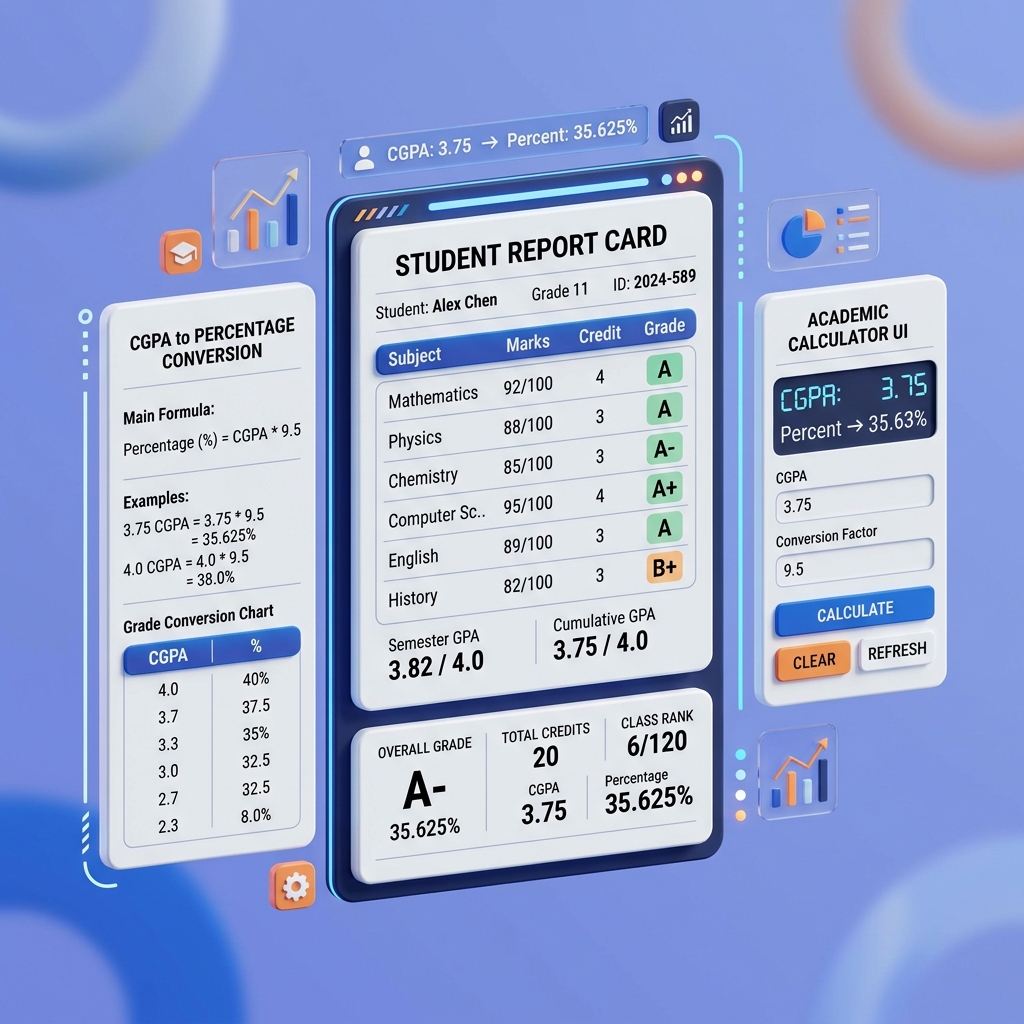
When filling out application forms for higher education (GATE, CAT, UPSC, MBA) or corporate recruitment drives in India, candidates are almost universally required to report their academic aggregate as a percentage. However, most schools, colleges, and central universities issue grade sheets using a Cumulative Grade Point Average (CGPA) on a 10-point or 4-point scale.
Because each academic institution defines its own grading policy, applying a generic formula can cause discrepancy in your official applications. This reference guide details the exact conversion multipliers across major Indian boards and universities.
Quick Reference Conversion Table
Check the back of your official marksheet or degree transcript first — universities print their specific conversion formula on the reverse side of grade cards.
| University / Board | Standard Formula | Example (For 8.0 CGPA) |
|---|---|---|
| CBSE (Class 10) | CGPA × 9.5 | 8.0 × 9.5 = 76.00% |
| Visvesvaraya Tech University (VTU) | (CGPA - 0.75) × 10 | (8.0 - 0.75) × 10 = 72.50% |
| Mumbai University (MU) | (CGPA × 7.1) + 11 | (8.0 × 7.1) + 11 = 67.80% |
| Anna University | CGPA × 10 | 8.0 × 10 = 80.00% |
| AKTU / UPTU | (CGPA - 0.75) × 10 | (8.0 - 0.75) × 10 = 72.50% |
| Standard UGC 10-Point System | CGPA × 9.5 (if unspecified) | 8.0 × 9.5 = 76.00% |
Important Warning: Mismatched percentage reporting during document verification (e.g. UPSC, SSC, or PSU hiring) can lead to disqualification. Always rely on the exact multiplier specified by your degree-granting body.
How Cumulative Grade Point Average (CGPA) is Calculated
CGPA represents the overall weighted average grade point across all completed semesters or academic subjects.
$$\text{CGPA} = \frac{\sum (\text{Course Credits} \times \text{Grade Point})}{\text{Total Course Credits}}$$
Step-by-Step Breakdown:
- Multiply Credits by Grade Points: Multiply each subject's credit rating by your earned grade point value.
- Sum Credit Points: Add all calculated course points across all semesters.
- Divide by Total Attempted Credits: Divide total earned points by total registered credits.
Why CBSE Uses the 9.5 Multiplier
Students frequently ask why CBSE uses 9.5 rather than 10. The Central Board analyzed historical examination records and found that top performers scoring between 91% and 100% (A1 Grade) had an average mark of 95%. Dividing 95 by 10 yields the 9.5 standard multiplier.
For example, a student holding an 8.6 CGPA under CBSE achieves:
$$\text{Percentage} = 8.6 \times 9.5 = 81.7\%$$
Detailed Institutional Examples
1. VTU Karnataka
VTU applies a deduction offset of 0.75 before scaling:- Formula:
(CGPA - 0.75) × 10 - For a 7.8 CGPA:
(7.8 - 0.75) × 10 = 7.05 × 10 = 70.5%
2. Mumbai University
Mumbai University applies a modified regression linear formula for its 10-point choice-based credit system:- Formula:
(CGPA × 7.1) + 11 - For an 8.4 CGPA:
(8.4 × 7.1) + 11 = 59.64 + 11 = 70.64%
Frequently Asked Questions
What is the percentage equivalent of 8.5 CGPA?
Under CBSE or UGC 9.5 multiplier rules, 8.5 CGPA = 80.75%. Under direct 10x multiplier systems (like Anna University), 8.5 CGPA = 85.00%.How do I convert a US 4.0 scale GPA to an Indian Percentage?
A 4.0 GPA scale cannot be directly converted with a single formula because US grading curves differ. Official bodies like WES evaluate transcripts individually. Generally, multiplying a 4.0 GPA by 2.5 converts it to an approximate 10-point scale, after which regional conversion rules apply.Automate Your Grade Calculation
Avoid calculation mistakes on job or admission forms. Use our instant, secure CGPA to Percentage Calculator — zero registration needed.